A Video MPI is a short video recorded by a technician during a multi-point inspection, showing the customer exactly what needs attention on their vehicle. It's texted directly to the customer, who can approve the work with a tap. The data is overwhelming. When a customer receives an MPI with photo or video, 51% approve the recommended work. Without it, only 24% do (J.D. Power 2024 ASI Study). And the 2026 J.D. Power CSI Study shows 64% of customers want photo or video documentation with their MPI, but only 26% to 44% actually receive it (J.D. Power 2026 CSI Study). That's not a sales gap. That's a customer-demand gap.
Key takeaways:
- Video MPI more than doubles approval rates on recommended work (24% to 51%, J.D. Power 2024 ASI).
- Customer demand is huge and unmet. 64% of customers want photo/video with their MPI. Only 26% of mass market and 44% of premium customers actually get it (J.D. Power 2026 CSI).
- Advisor CSI jumps 31 points when photo/video accompanies the MPI (911 vs. 880 on J.D. Power's 1,000-point scale, J.D. Power 2024 CSI).
- Real-world revenue impact is measurable. Porsche Centre Langley saw repair orders averaging $1,993.58 higher with videos than without (Kimoby case study).
- The tech exists and it's easy. Kimoby's Video MPI runs on the advisor's phone. Kimoby's Hands-Free MPI runs on the tech's face.
Service departments and customers have a trust problem. Customers walk in defensive, half-expecting to hear that they need $1,200 in work they don't actually need. Technicians who genuinely want to keep those customers safe watch their recommendations get met with skepticism, suspicion, and "let me think about it."
The gap between what a tech sees on the lift and what a customer believes in the waiting room is where thousands of dollars in declined service disappear every day. The fix is simpler than most dealers think. It's a 30-second video.
Table of Contents
- What is a Video MPI?
- Do customers actually care about Video MPIs?
- What Video MPIs do for approval rates, CSI, and revenue
- Case study: Porsche Centre Langley
- Why your team will actually adopt it
- How Kimoby makes Video MPI simple
- FAQ
What is a Video MPI?
A Video Multi-Point Inspection (Video MPI) is a short video recorded by a service technician during a standard MPI, showing the customer exactly what needs attention on their vehicle. Worn brake pads, a leaking gasket, tire tread at the wear bar. The video is texted directly to the customer, who can review it on their phone and approve the recommended work with a single tap.
A traditional MPI is a checklist. A Video MPI is proof. The customer doesn't have to trust that the brake pads are worn. They can see them. That's the whole difference.
What makes Video MPI work isn't the video itself. It's the shift from a phone call debate ("your brakes are at 3mm, you need to replace them") to an interactive approval ("here's the 30-second video, here's the estimate, tap yes or no"). The customer moves from skeptical to informed. The advisor stops defending recommendations and starts writing ROs.
Do customers actually care about Video MPIs?
Short answer: yes, and the data is overwhelming.
The most telling number is from the 2026 J.D. Power Customer Service Index Study. 64% of customers say they want photo or video documentation with their MPI. But only 26% of mass-market customers and 44% of premium customers actually receive it (J.D. Power 2026 CSI Study). The gap between what customers want and what they get is one of the largest unmet demands in the entire service experience.
Every dealership that doesn't offer Video MPI is actively disappointing roughly four out of every ten premium customers and nearly four out of every five mass-market ones. That's not a sales-tactic conversation. That's a customer experience conversation.
Some dealerships and OEM programs are also moving toward video-documented inspections as a trust and transparency standard. Expect more of that pressure in the coming years as customer expectations harden.
What Video MPIs do for approval rates, CSI, and revenue
The business case breaks into three numbers, each from a different credible source.
Approval rates more than double
J.D. Power's 2024 Aftermarket Service Index Study tracked customers who received an MPI with and without photo/video evidence. The result: 51% of customers who got photo or video approved the recommended work. Only 24% of those without it did (J.D. Power 2024 ASI). Visual evidence more than doubles the yes rate.
That isn't an upsell trick. Customers weren't being sold harder. They were being shown the actual problem, and they said yes because they could see it for themselves.
CSI scores climb 31 points
J.D. Power's 2024 CSI Study found that when service advisors provide photos or videos alongside the MPI, their customer satisfaction score averages 911 out of 1,000, versus 880 without photos or videos. That's a 31-point lift on J.D. Power's 1,000-point scale (J.D. Power 2024 CSI). For context, that's the difference between a good store and a great one.
Revenue per RO goes up
Industry analysis from Digital Dealer estimates that dealerships using video communication see dollars per repair order increase by 35% to 60% (Digital Dealer, 2022, vendor-authored). The exact number varies by store, brand, and implementation. But the directional evidence across multiple sources points the same way: customers who see what's wrong approve more, and they approve more completely.
Real-world results confirm it. Porsche Centre Langley's ROs averaged $1,993.58 higher when a video was attached than when one wasn't (Kimoby case study). One dealership. One number. More on that in a moment.
The approval, satisfaction, and revenue picture
| Metric | Without video/photo | With video/photo | Source |
|---|---|---|---|
| Approval rate on recommended work | 24% | 51% | J.D. Power 2024 ASI |
| Advisor CSI score (out of 1,000) | 880 | 911 | J.D. Power 2024 CSI |
| Customers who want it | 64% want it | Only 26% to 44% receive it | J.D. Power 2026 CSI |
| Avg RO increase (Porsche Centre Langley) | Baseline | +$1,993.58 | Kimoby |
Case study: How Porsche Centre Langley added $1,993 per RO
Porsche Centre Langley had the same problem every franchised store has. Customers were skeptical of recommended repairs. CP/RO numbers suffered. Advisors spent hours defending work that a tech had already confirmed was needed.
The team had already seen other dealerships in their network running Video MPI and wanted to try it. Their first attempt was with a competing video tool that was too complicated. Staff adoption never took off, and the results never materialized.
They switched to Kimoby. Within weeks, more than 90% of the service advisors were actively using Video MPI (Porsche Centre Langley case study).
The results:
- Repair orders with videos averaged $1,993.58 higher than ROs without videos.
- Interactive estimates added another $1,681.90 on top of that.
- Time cars spent on the hoist dropped because customers could approve repairs from their phones with a tap, instead of the advisor playing phone tag.
- Advisors could track estimate activity and follow up at the right moment instead of guessing.
"Kimoby is so intuitive, there is almost no learning curve. I have employees with little to no computer experience, and they were able to grasp everything in no time."
Brian Maguire, Fixed Operations Manager, Porsche Centre Langley
One dealership, one set of numbers. Your mileage will vary. But the pattern is consistent across the industry: when customers see what's wrong, they approve more, they approve faster, and they spend more per visit.
Why your team will actually adopt it (not fight it)
Every service manager has been through this: you roll out new technology, and within two weeks it's being ignored. New tools get adopted when they make the job easier, not harder. Video MPI clears that bar because every role in the shop benefits directly.
- Technicians spend less time explaining. Instead of walking out to the write-up desk to explain a worn belt to the advisor, the tech shoots a 30-second video and moves on to the next car. The advisor gets the information straight from the source, and the customer sees it too.
- Advisors spend less time defending recommendations. The video does the explaining. Customers walk into the conversation already informed, and the advisor's job shifts from "selling" the work to processing an informed decision.
- Managers spend less time mediating. When a customer later says "I never approved that," the video and the timestamped approval are both in the record.
Most teams that initially push back adapt within days once they see how much time it saves. The ones who don't adapt usually had a bad first tool. The answer there is a better tool, not a slower one.
How Kimoby makes Video MPI simple
Kimoby's Video MPI is built so every person in the shop can use it without training. Here's what that actually means.
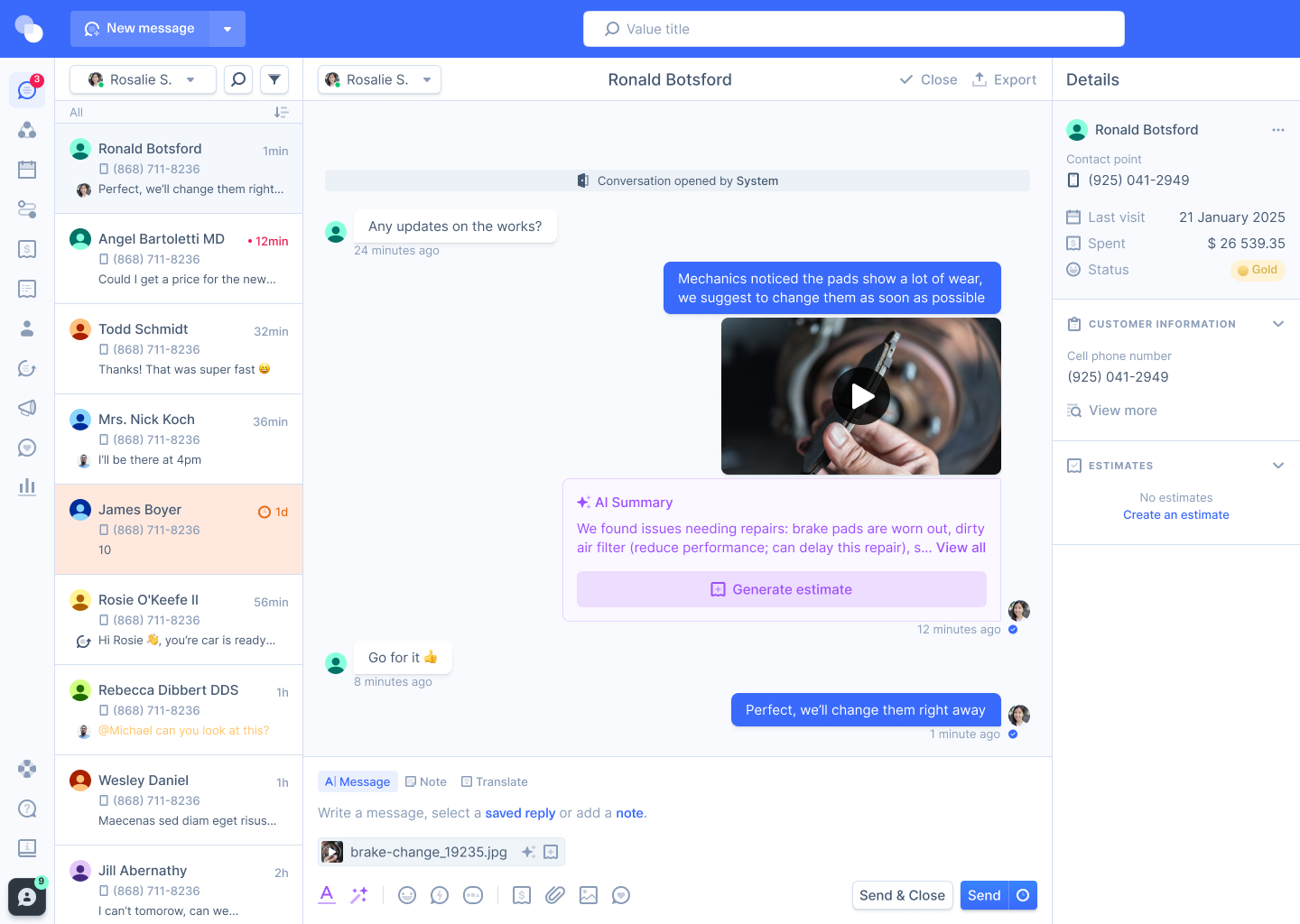
- Record from a phone or tablet. No separate camera, no special rig. A tech shoots a 30-second video and sends it to the advisor in the app. The advisor sends it to the customer in one tap.
- AI-generated estimates. Kimoby's AI reads the tech's video and generates a draft estimate with the recommended work. The advisor reviews and sends. What used to take 20 minutes of typing takes 2.
- AI subtitles and noise reduction. Shops are loud. Kimoby automatically cleans up audio and adds subtitles, so the customer actually understands what the tech is saying.
- Built-in training. The platform includes onboarding for techs and advisors, which is why stores like Porsche Centre Langley reach 90% staff adoption in weeks.
- Internal collaboration. Kimoby's Conversations view keeps the tech, advisor, and parts counter on the same thread. No sticky notes, no missed hand-offs.
- Everything in one searchable record. Video, estimate, customer approval, invoice, follow-up. All tied to the customer and pulled directly from your DMS.
The next step: Hands-Free MPI with Meta Glasses
For shops that want to push even further, Kimoby offers Hands-Free MPI using Meta Glasses. The tech wears the glasses and narrates the inspection while they work. No phone. No tablet. No interruption to their workflow. The video is recorded, captioned, and routed to the advisor automatically, ready to send.
Hands-free is where video MPI is going. The stores that get there first will have a structural advantage over the ones still figuring out tablets.
FAQ: Video MPI questions answered
What is a Video MPI?
A Video Multi-Point Inspection is a short video recorded by a service technician during a standard MPI, showing the customer exactly what needs attention on their vehicle. The video is texted directly to the customer, who can review it and approve the recommended work from their phone. It replaces the traditional phone-call explanation with visual proof.
How much does Video MPI actually improve approval rates?
J.D. Power's 2024 Aftermarket Service Index Study found that 51% of customers who received an MPI with photo or video had the recommended work done, compared to only 24% of customers who didn't receive visual evidence. That's more than double the approval rate.
Do customers actually want Video MPIs?
Yes, overwhelmingly. The 2026 J.D. Power CSI Study found that 64% of customers want photo or video documentation with their MPI. Only 26% of mass-market customers and 44% of premium customers currently receive it. For most dealerships, offering Video MPI closes a gap that customers are actively asking for.
Does Video MPI improve CSI scores?
Yes. J.D. Power's 2024 CSI Study shows that service advisors average a CSI score of 911 out of 1,000 when they provide photos or videos with the MPI, compared to 880 without. That 31-point lift is the difference between a good service advisor and a top-tier one.
How much revenue does Video MPI add per repair order?
It varies by store, brand, and implementation. Industry estimates suggest dollars per RO can increase by 35% to 60% when video is added to the process. Specific dealership results are stronger: Porsche Centre Langley reported that repair orders with videos averaged $1,993.58 higher than ROs without videos. Your mileage will vary, but the directional impact is consistent.
Will my technicians and advisors actually use it?
Adoption is the hardest part, and it's where most dealerships fail on their first attempt. The platforms that succeed are the ones that are easy to learn and make the job faster, not slower. Porsche Centre Langley reached more than 90% advisor adoption of Kimoby's Video MPI within weeks, largely because the tool runs on a phone or tablet with no extra equipment and includes built-in training.
What's next beyond Video MPI?
Hands-free video inspections. Kimoby's Hands-Free MPI with Meta Glasses lets the tech record the inspection while they're working, without holding a phone or tablet. The video is captured, captioned, and routed to the advisor automatically. For high-volume shops, it eliminates the last remaining friction point in the video-inspection workflow.
Conclusion
Your customers are telling you, through independent survey data, that they want video with their inspections. 64% want it. Most dealerships still don't offer it. That gap is an opportunity: better approval rates, higher CSI, faster ROs, and measurably more revenue per visit.
The question isn't whether Video MPIs will become the industry standard. They already are. The only question is whether your store is closing the gap or letting it widen.
Sources
- J.D. Power 2024 U.S. Aftermarket Service Index (ASI) Study, via Auto Remarketing. 51% of customers who receive an MPI with photo/video have the recommended work done, vs. 24% without.
- J.D. Power 2026 U.S. Customer Service Index (CSI) Study. 64% of customers want photo/video with their MPI. Only 26% of mass market and 44% of premium customers receive it.
- J.D. Power 2024 U.S. Customer Service Index (CSI) Study. Advisor CSI averages 911 with photo/video, 880 without. A 31-point difference on the 1,000-point scale.
- Porsche Centre Langley Success Story, Kimoby. ROs with videos averaged $1,993.58 higher than ROs without. Interactive estimates added $1,681.90 on average. 90%+ advisor adoption.
- Digital Dealer (FlickFusion), "How to Use Video to Increase Your Service Revenue", May 2022. Dollars per RO increase 35% to 60% when customers receive their MPIs via video. Vendor-authored industry perspective.
/blog/thumbnails/calculator_csi-follow-ups.jpg)
How to Improve Automotive Service Department Communication
The Best Video Inspection Software for Dealership Service Departments