
Best CRM for Car Dealerships in North America (2026)
There is no single best CRM for car dealerships. The right one depends on which DMS you run, what kind of deals you do, and whether your team will actually use it. This guide sorts the major platforms by those three things.
Every rating below was pulled from G2 and Capterra directly, in August 2026, with the review count next to it. That second number matters more than the first. A 4.4 from 13 reviews and a 4.6 from 274 reviews are not the same signal.
The short answer
| If you are | Start with |
|---|---|
| A franchise group already on Cox Automotive products | VinSolutions |
| An enterprise group on the CDK DMS | CDK CRM (Elead) |
| An independent or BHPH dealer | AutoRaptor |
| A store whose team avoids the current CRM | DriveCentric |
| Heavy on special financing | ProMax |
| Operating in Canada | PBS Systems, Activix, or Dabadu XRM |
Now the detail, because fit matters more than ranking.
How to read dealership CRM ratings
Three things skew almost every automotive CRM score you will find online.
Review volume is tiny. Dealership software is a small category. Most automotive CRMs have fewer than 150 public reviews. Consumer software has thousands. A handful of enthusiastic reviews moves an automotive score a long way.
Vendors solicit reviews in waves. A profile that jumps from 5 reviews to 130 in a quarter usually reflects a marketing campaign, not a shift in product quality.
Scores go stale. Ratings get quoted from article to article long after the underlying profile has moved. Check the source and the date yourself before you rely on any number, including the ones here.
Salespeople and managers rate differently. This is the most useful thing to know. Salespeople reward interface and speed. Managers reward desking, reporting, and control. The same platform can be a favorite on the floor and a frustration in the tower.
Read the reviews, not just the number. Then demo with your actual team.
Verified ratings at a glance
Pulled from G2 and Capterra in August 2026.
| Platform | Owner | Rating | Reviews | Source |
|---|---|---|---|---|
| AutoRaptor CRM | AutoRaptor | 4.6 | 274 | Capterra |
| CDK CRM (Elead) | CDK Global | 4.4 | 76 | G2 |
| Tekion | Tekion | 4.4 | 13 | G2 |
| VinSolutions Connect CRM | Cox Automotive | 4.2 | 109 | G2 |
| CDK (platform) | CDK Global | 4.0 | 116 | G2 |
| DriveCentric | DriveCentric | 4.0 | 4 | Capterra |
| DealerSocket | Solera | 3.8 | 65 | G2 |
| Dabadu XRM | Dabadu | 5.0 | 129 | G2 |
Two notes on this table.
DriveCentric also holds a 5.0 on G2, from one review. That is very few reviews for a product running in roughly 2,300 rooftops, so treat any aggregate score for it with caution and weight your own demo more heavily.
Dabadu has 129 reviews and not one of them is below 5.0. That almost never happens with real software. Worth a closer look at the individual reviews before you draw conclusions.
The major platforms
VinSolutions Connect CRM
Rating: 4.2 on G2 from 109 reviews. Ease of use scores 8.8, quality of support 8.4.
Best for: Franchise groups already running Cox Automotive products.
VinSolutions serves roughly 5,000 to 6,500 rooftops. Its real advantage is data. Cox Automotive owns Autotrader, Kelley Blue Book, Dealer.com, and Dealertrack, and VinSolutions draws behavioral signals from that ecosystem that standalone CRMs cannot reach.
Managers consistently defend it for desking depth and reporting. Reviewers on Capterra praise multi-store management from a single login and note that even less technical salespeople pick it up.
Watch out for: a dated, click-heavy interface. Duplicate lead handling comes up repeatedly, and several reviewers report month-end slowdowns.
CDK CRM (Elead)
Rating: 4.4 on G2 from 76 reviews. The broader CDK platform sits at 4.0 from 116 reviews.
Best for: Enterprise groups running the CDK DMS across 10 or more rooftops.
The case for Elead is native integration. If your DMS is CDK, inventory, deal, and service data syncs directly instead of through a third-party bridge or a nightly batch. For a 20-rooftop group, that removes a layer of daily friction that no interface comparison outweighs.
Lead routing, escalation rules, and enterprise reporting are deep. The tablet showroom app lets an advisor move a customer from greeting to signature without leaving their side.
Watch out for: the flip side of that same coin. If you are not on the CDK DMS, most of the advantage disappears.
DriveCentric
Rating: 4.0 on Capterra from 4 reviews. 5.0 on G2 from 1 review. Roughly 2,300 dealerships.
Best for: Stores where the team actively avoids the current CRM.
DriveCentric built around conversation threads rather than data entry screens. Text, email, call, video, and chat live in one feed per customer. Reviewers who like it say the interface is clean and the communication flow is unmatched. One Capterra reviewer who had used most CRMs on the market called it the best and most seamless.
Watch out for: duplicate customer records and salesperson attribution conflicts, which come up more than once. Desking, particularly lease calculations, is the most cited functional gap.
One review matters for a different reason. A salesperson flagged the absence of a service portal, noting that salespeople are not alerted when their own customers come into the service department.
Hold onto that one. It is not a DriveCentric problem. It is a category problem, and we come back to it below.
DealerSocket
Rating: 3.8 on G2 from 65 reviews. The lowest score among the major franchise platforms.
Best for: Stores already standardized on Solera products.
DealerSocket has had a difficult few years. Solera acquired it in 2021, and reviewers since then have concentrated their criticism on support responsiveness and pace of updates. Layoffs following a restructuring added to the uncertainty.
The honest counterweight: on February 4, 2026, Solera announced a substantial R&D investment in the CRM, including conversational AI lead response and AI lead scoring, launched at NADA 2026. That is a real commitment, and it is too early to judge the result.
Watch out for: the gap between announcement and delivery. Ask what has actually shipped since February, and talk to a reference store that has been live on the new build.
Tekion Automotive Retail Cloud
Rating: 4.4 on G2 from 13 reviews. Small sample, so weight it accordingly.
Best for: Dealers who want CRM and DMS on one cloud-native architecture.
Tekion's pitch is consolidation. One platform for CRM, DMS, accounting, and service, built cloud-native rather than retrofitted. Reviewers coming off legacy systems describe the transition as faster than expected and the interface as genuinely modern.
Watch out for: how much the experience varies. Opinions run wide in both directions, and which one you get seems to depend heavily on which modules you deploy and how mature they are. Ask for references from stores running your exact configuration.
ProMax
Best for: Stores that do a lot of special financing.
ProMax starts from the deal instead of the lead. If a lot of your customers have credit trouble, being able to match someone's credit to the right car and the right lender before the test drive matters more than a nice interface.
Watch out for: a thin review base of 24 on Capterra, with sentiment around 71 percent positive and 21 percent negative. Recurring complaints are reporting granularity and duplicate records that do not merge automatically.
AutoRaptor
Rating: 4.6 on Capterra from 274 reviews. Ease of use 4.7, customer service 4.8, value for money 4.5. Published starting price of $399 per month.
Best for: Independent and BHPH dealers.
This is the largest verified review base of any dedicated automotive CRM we found, and the sentiment is strongly positive at 91 percent. It is built for independents rather than adapted from a franchise product, and it publishes its pricing, which almost nobody else in this category does.
Watch out for: the contract. The most substantive complaint on the current page concerns an automatic annual renewal clause, plus texting overage charges a dealer reported doubling their monthly bill. Reviewers also mention lag, downtime, and limited AI compared to the larger platforms.
None of that is disqualifying. It does mean reading the agreement closely before signing.
Canadian dealership CRMs
Most roundups written for the US market skip this entirely. If you operate in Canada, the requirements are different, and a US platform that ignores them will create work for you every week.
What a Canadian store needs that a US platform often will not have:
- Bilingual French and English support
- Compliance with PIPEDA, Quebec's Law 25, and CASL
- Reporting in Canadian dollars
- Certifications from Canadian OEM programs
- Support for provincial licensing, including OMVIC in Ontario, AMVIC in Alberta, and the SAAQ in Quebec
One thing changes the math here: the Canadian market has consolidated. On November 10, 2022, Cox Automotive sold the Canadian operations of VinSolutions, Dealertrack, Dealer.com, Xtime, and Kelley Blue Book to TRADER Corporation. Activix has been in the TRADER family since a strategic investment in May 2021, and sits inside TRADER's AutoSync software suite. So two options a Canadian dealer is likely to shortlist trace back to the same parent company.
The practical takeaway: ask any US-headquartered vendor exactly what they sell and support in Canada today. The answer is often not the same product US dealers are buying.
PBS Systems dominates Canadian DMS with roughly 3,500 dealerships and bundles CRM functionality with bilingual support and Canadian regulatory compliance built in. For Canadian dealers who want one vendor, it is the low-risk choice.
Activix reports over 840 dealerships in Canada with certifications across a wide set of OEM programs. Founded in Quebec, it is the strongest option for groups that want a dedicated CRM rather than one bundled into a DMS. It sits inside TRADER's AutoSync suite, which is worth knowing if you are also evaluating other AutoSync products.
Dabadu XRM holds Kia Canada and Hyundai Canada certifications and offers AI call summarization. Worth noting for anyone evaluating it: Ontario's 401 Group of Companies acquired Dabadu in April 2026. The 401 Group was an early customer running it across roughly 50 locations. Dealer-owned vendors can be excellent because the roadmap tracks real operational needs. Ask how the acquisition affects the roadmap for dealers outside the group.
Quorum offers XSELLERATOR, a Canadian DMS with customer management functionality, used across GM, Chrysler, Hyundai, Kia, Nissan, and Subaru stores.
How to choose
Five factors, in the order that actually predicts satisfaction.
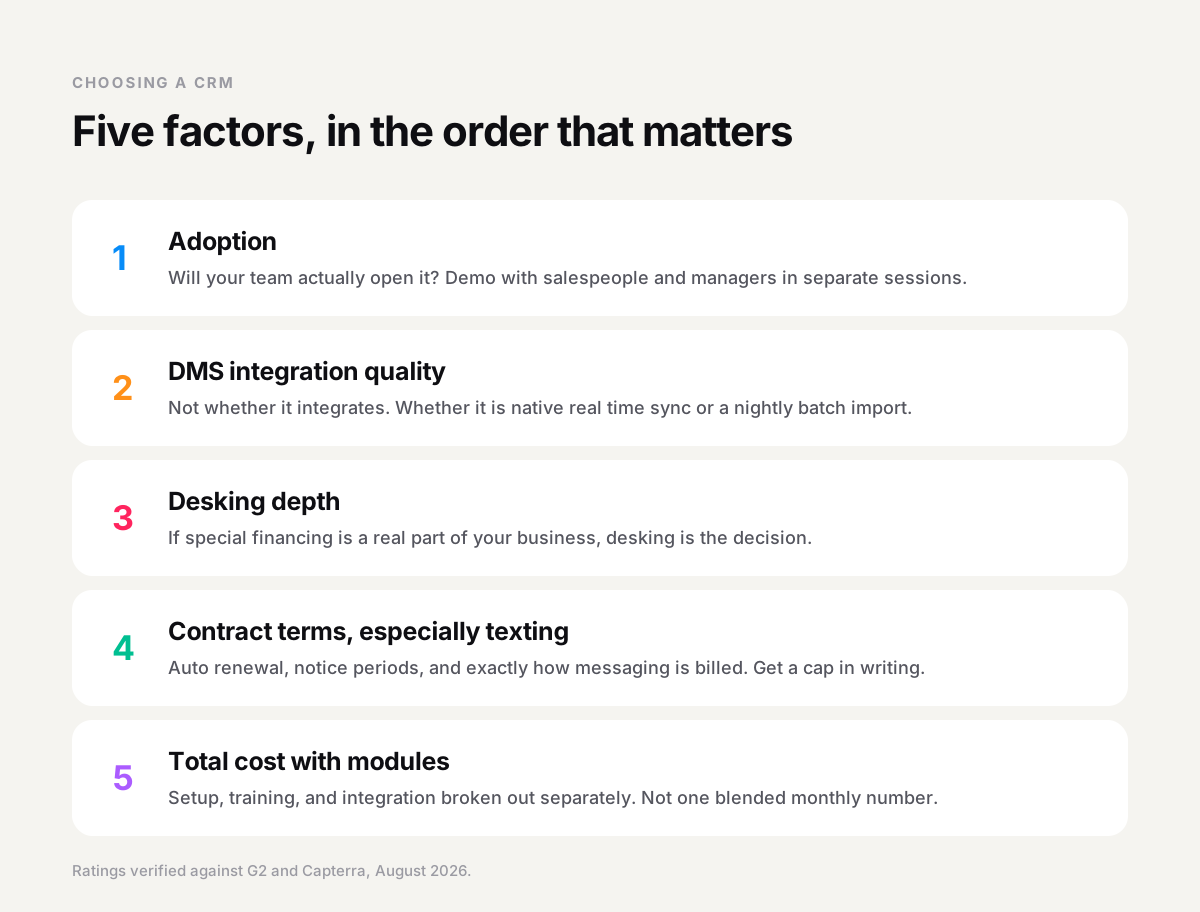
Adoption first. Ask working salespeople which CRM to buy and the most common answer is that the CRM is not the problem. It is whether anyone manages it, enforces it, and trains on it. Dealers describe running a capable platform badly and getting nothing out of it, and that shows up far more often than complaints about any specific product.
So demo with your actual salespeople and your actual managers, in separate sessions, and count who wants which one. One dealer group ran that test at every location. Salespeople chose the modern interface. Managers chose the deeper reporting. Knowing which group you need to satisfy is the real decision.
DMS integration quality. Not whether it integrates. How. Native real-time sync and a nightly batch import are different products wearing the same word.
Desking depth, if it matters. If subprime or complex leases are a real part of your business, desking is not a feature comparison. It is the decision.
Contract terms, especially texting. Ask about auto-renewal, notice periods, and what happens to your data if you leave. Then ask specifically how messaging is billed. Per-message pricing that looks like a fraction of a cent turns into a real bill at campaign volume, and dealers report monthly invoices arriving at double what they budgeted. Get a flat rate or a hard cap in writing. Several of the most substantive negative reviews across every platform in this guide are about billing and contracts, not software.
Total cost with modules. Most automotive CRMs quote custom pricing, typically in the range of $500 to $3,000 per rooftop per month, with add-ons stacking on top. Get it in writing with setup, training, and integration broken out.
The gap every CRM on this list shares
Go back to that DriveCentric review, the one about the missing service portal.
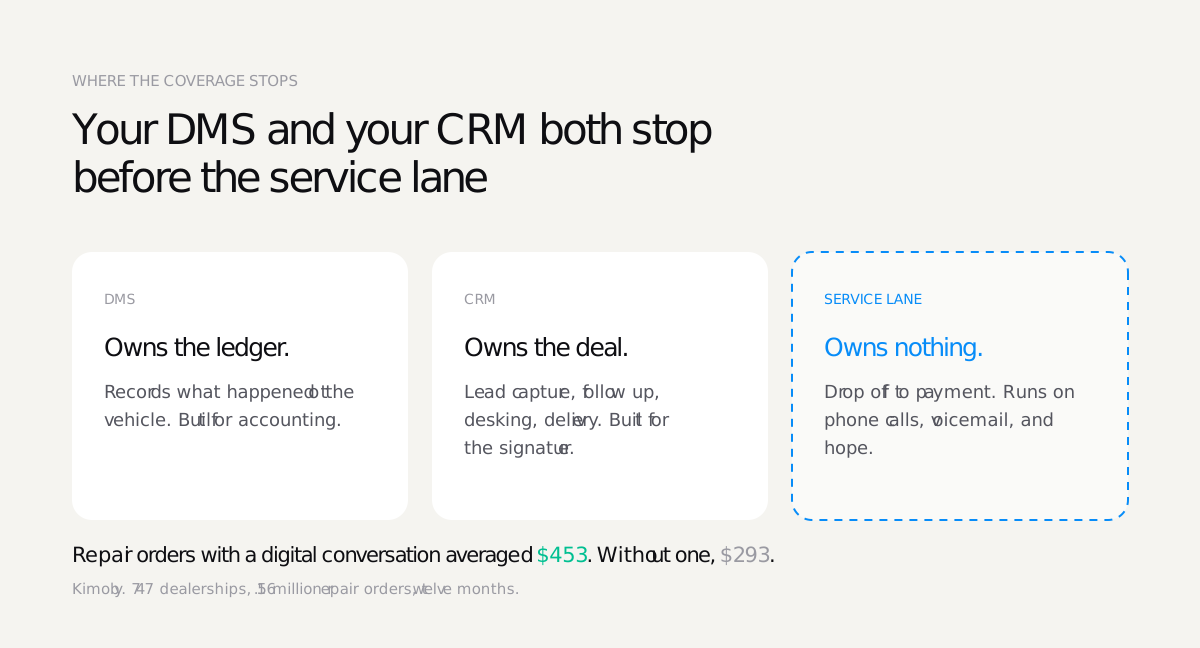
That salesperson identified something bigger than a missing feature. Every CRM in this guide was built to sell the first car. Capture the lead, work the follow-up, desk the deal, deliver. All of it points at one thing: getting a signature.
But the showroom sells the first car. The service lane sells the second, third, and fourth. That is fixed ops, and it runs on different tooling. And the tooling built for one does not transfer to the other.
Your DMS records what happened to the vehicle. Your CRM manages the path to the sale. Neither was designed for what happens between 7:45 AM drop-off and the moment a customer approves a $1,200 repair. That space runs on phone calls, voicemail, and hope.
The cost is measurable. Across 747 dealership accounts, 16.5 million repair orders, and $5.65 billion in service revenue over twelve months, repair orders with a digital conversation attached averaged $453. Without one, they averaged $293. That is a $160 gap on every single RO.
The mechanism is speed. Median approval time on a digital estimate is 6 minutes. By phone, it is 22 to 23 hours. The customer did not decline the work. Nobody reached them while the technician still had the car on the lift.
None of that is a CRM failure. You cannot fix it by switching CRMs, because no CRM on this list is trying to solve it.
What to run alongside your CRM
Kimoby is not a CRM, and it will not replace one. With Kimoby, you run the layer your CRM was never built for: the service lane, from write-up to payment.
Where the CRM owns the path to the sale, the Dealership Engagement System (DES)™ owns the relationship after it. Four modules extend the Service Lane OS:
- Kimoby Voice answers the calls your advisors cannot get to during the 8:00 to 11:30 AM rush, when the write-up line is deepest and the phone rings hardest.
- Kimoby Pay closes the RO from the customer's phone, mobile or in person, so nobody waits at a cashier counter.
- Kimoby Go tracks every loaner and automates the contracts, so you stop turning away customers over vehicles that came back yesterday.
- Kimoby Grow brings back the customers who quietly stopped coming.
It sits on top of your DMS and works alongside whichever CRM you choose, including every platform in this guide. See the full DMS integration list, or the wider service department software landscape.
The dealerships that win service are not the ones with the best CRM. They are the ones whose customers never sit in silence wondering what is happening to their car.
Frequently asked questions
What is the best CRM for car dealerships?
There is no single answer. VinSolutions leads for Cox Automotive groups and for managers who want deep reporting. CDK Elead leads for enterprise groups on the CDK DMS. AutoRaptor has the strongest verified review base for independent dealers. DriveCentric leads on salesperson adoption. For Canada, PBS Systems and Activix carry the bilingual and regulatory advantages that US platforms lack.
How much does a dealership CRM cost?
Most quote custom pricing per rooftop, commonly $500 to $3,000 per month, with modules priced separately. AutoRaptor publishes a starting price of $399 per month. Always ask for setup, training, and integration costs in writing.
Is a CRM the same as a DMS?
No. Your DMS handles accounting, inventory, repair orders, and the system of record. Your CRM handles leads, follow-up, and the path to a sale. They solve different problems and most dealerships run both.
Do I need a separate tool for my service department?
Your CRM tracks the customer through the sale. Your DMS tracks the repair order. Neither manages the conversation during the service visit, which is where approval speed determines revenue. Most dealerships add a dedicated service lane layer for that reason.
Which dealership CRMs work in Canada?
PBS Systems, Activix, Dabadu XRM, and Quorum are built for the Canadian market with bilingual support and compliance with PIPEDA, Law 25, and CASL. VinSolutions and other US platforms operate in Canada but generally without those advantages.
Sources
- G2 profiles for VinSolutions and CDK, CDK CRM and DealerSocket, Tekion, DriveCentric, and Dabadu XRM. Retrieved August 2026.
- Capterra profiles for AutoRaptor CRM, DriveCentric, and ProMax Unlimited. Retrieved August 2026.
- Solera, "Solera Announces Landmark AI Investment and Major DealerSocket CRM Upgrade Ahead of NADA Show 2026," February 4, 2026.
- Automotive News, "401 Group buys Dabadu to boost dealer CRM, AI growth," April 8, 2026.
- Auto Remarketing Canada, "Cox Automotive sells Canadian operations of Dealertrack, VinSolutions, Dealer.com, Xtime and KBB to TRADER," November 10, 2022.
- TRADER Corporation, "Activix Receives Strategic Investment to Fuel Growth," May 27, 2021.
- Activix, dealership count as published on activix.ca.
- Kimoby, April 2026. 747 dealership accounts, 16.5 million repair orders, 4.36 million unique customers, $5.65 billion in service revenue, trailing twelve months.

Best Auto Dealership Software & Tools for Service Managers and GMs (2026 Guide)
/Screenshot%202023-04-28%20at%206.11.11%20PM.png)
Using Dealership Texting Software to Improve CLV & Profit