
Last updated: October 7, 2026
Quick answer: Texting your service customers changes two things you can measure. Across 871 dealerships, repair orders with a digital conversation averaged $455.08 in customer pay, against $291.12 without one. Customers with a text conversation on their RO also came back more often, about 6 points higher retention. The catch is that 76.3% of repair orders still close with no conversation at all.
Do service customers really want texts?
Yes. In DriveSure's 2023 service retention report, 68% of customers said they prefer text updates during a service visit, against 18% who prefer a phone call. Among 18 to 34 year olds, 56% prefer texting to email (24%).1
Think about your own day. How many calls did you let go to voicemail between meetings this week? Now count the texts you ignored. Your customers work the same way.
They also want to see the work. 64% of service customers want a photo or video with their inspection, but only 26% of mass-market customers get one (J.D. Power, 2026).2
How does texting change what a customer spends?
This is the number to look at first. In our Cost of Silence report, which covers 871 dealerships and 16.8 million repair orders, ROs with a digital conversation averaged $455.08 in customer pay. ROs without one averaged $291.12. That's $163.96 per RO.3
Is all of that because of the texts? No. Bigger jobs naturally generate more conversation, so part of the gap would be there anyway. But the direction is clear, and most stores are leaving it on the table. 76.3% of repair orders on the platform still close with no digital conversation attached.
Speed is a big part of it. When the estimate lands on the customer's phone with photos and line items, the median time to approval is 6 minutes, and 88.2% are approved within an hour. By phone, it's 22 to 23 hours. That's a car sitting on a lift for a day while your advisor plays phone tag.
Does texting help customers come back?
Yes, and this is where customer lifetime value comes in. Across the same 871 stores, customers with a digital conversation on their RO had retention about 6 points higher. Customers who received a campaign came back 9 to 10 points more often.3
For context, NADA targets 72% year-over-year retention. These stores sit at 65.8% on a strict cohort basis, and at 73.9% when you count the customers who came back after someone reached out. That 8-point spread is what outreach buys you.
The customers you win back aren't small tickets either. A customer returning after 13 months or more spends $549.28 on that visit, against $320.76 on every other RO. They usually come back with a list of deferred work.
Which texts make the biggest difference?
Not every text is worth the same. Here's where we see the most impact, in the order a visit happens.
An intro text from the advisor
When the RO opens, the customer gets a text with their advisor's name. It's a small thing. It also tells the customer exactly who to reply to, which cuts the "who do I call?" phone tag later in the day.
Status updates
Automated updates go out as the work moves along. The customer stops calling to ask where the car is, and your advisor stops answering the same question 20 times a day.
Video inspections with the estimate
The tech records a short video of the worn brakes. Shop noise gets filtered out and captions get added. On Service Lane OS Pro, the estimate is drafted from what the tech says on camera, and the advisor reviews it before it goes out.
The customer watches it in the parking lot at work and approves line by line from their phone. Here's the full workflow in our video MPI guide.
Text-to-pay
The customer pays from the same thread, before they get to the counter. Affirm financing is there for bigger jobs. Only 4.7% of repair orders get a digital payment request today, which is why most stores still have a line at the cashier at 5 PM. More on mobile payments.
A CSI check-in before the OEM survey
After pickup, a short text asks how the visit went. Replies are read for sentiment, and your team gets an alert when a customer is unhappy. You fix it before the OEM survey shows up, not after. Our CSI guide goes deeper on this.
Campaigns that bring them back
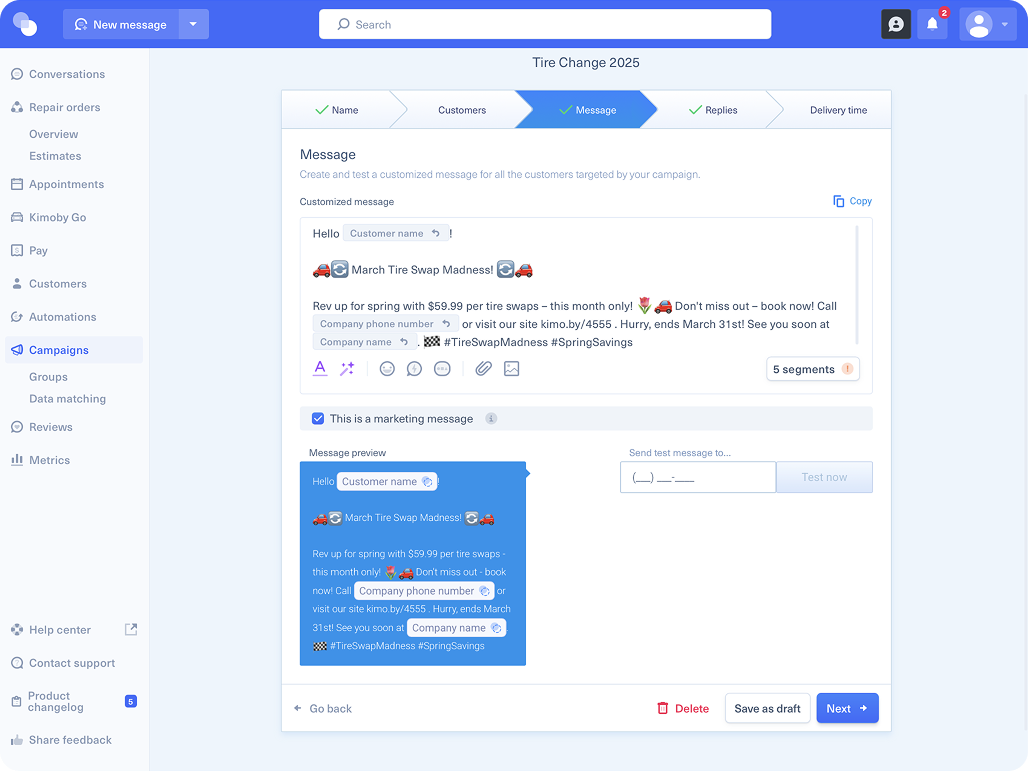
Maintenance reminders, recalls, declined work, tire season. You build the audience from your DMS data, like service history or the date of the last visit. Then the texts go out on schedule. Across the platform, outbound campaigns booked 154,003 appointments and drove $50.5 million in attributed service revenue.3
Declined work is usually the quickest win. Here's how to follow up on declined service.
Why isn't the texting in your DMS or phone system enough?
To be fair, most DMSs and phone systems can send a text. The difference shows up in the details.
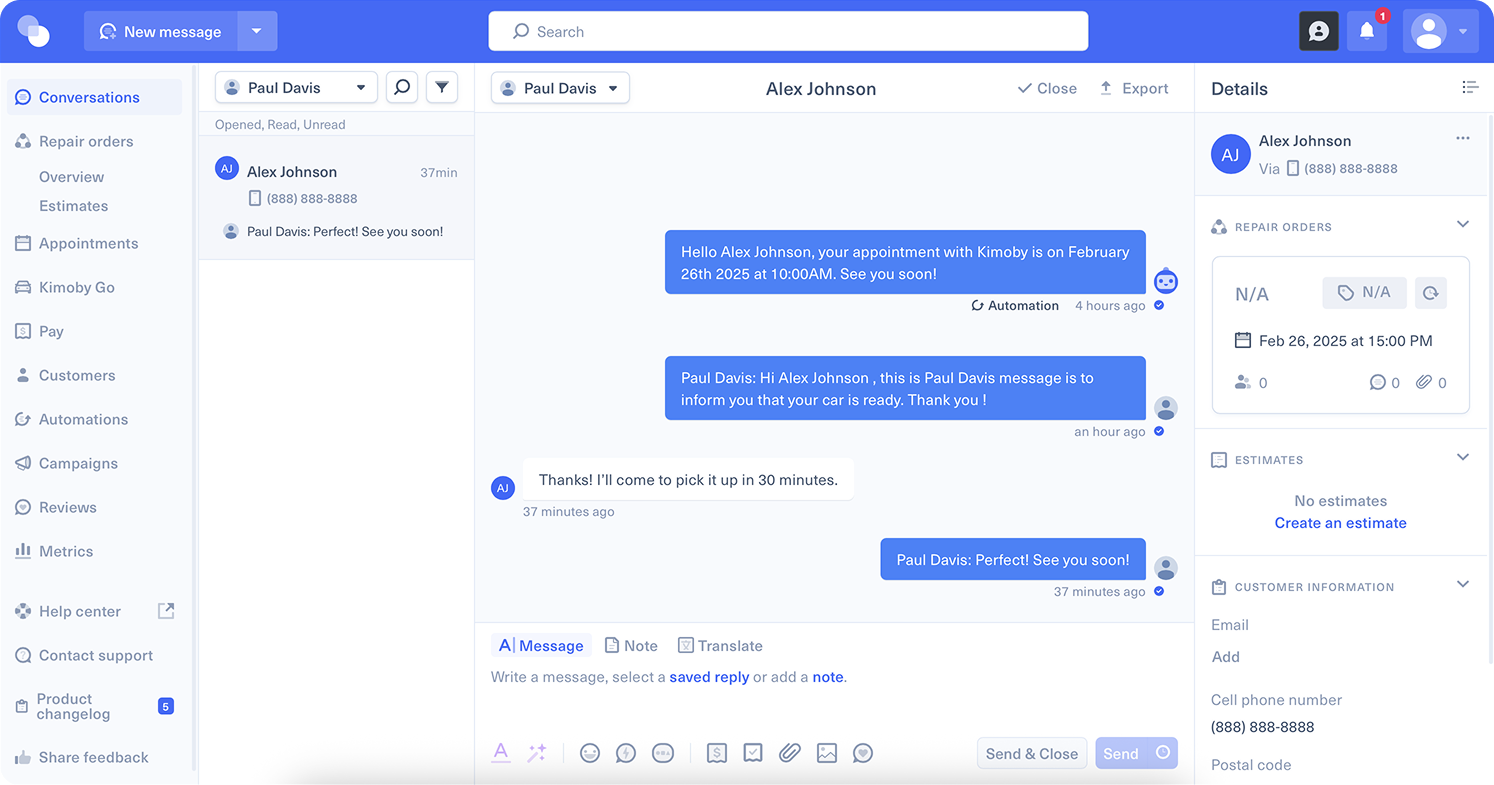
- Some tools only let you text a customer while an RO is open. With Kimoby, you can text any customer in your database, any time, from your dealership's own number.
- Every message lives in one thread per customer, right next to their repair orders. Your advisors aren't flipping between screens.
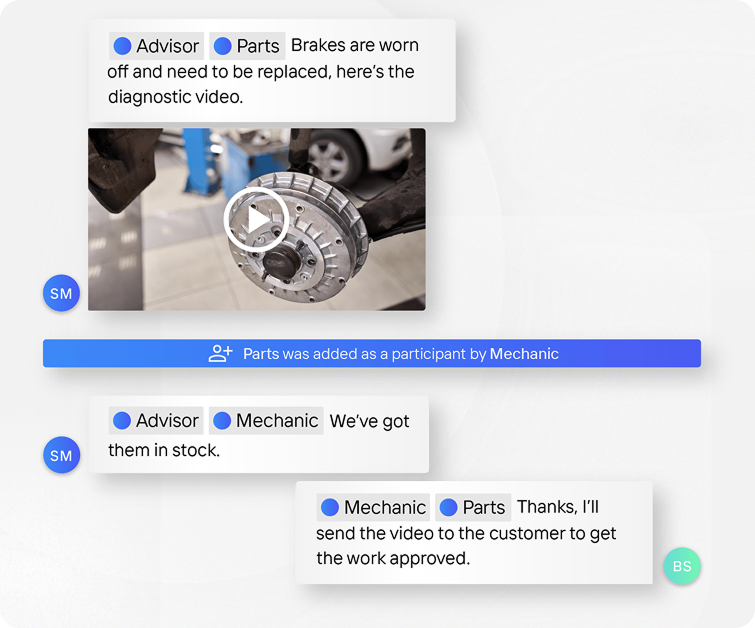
- Your techs and advisors can talk to each other inside the same conversation, and the customer doesn't see it.
- Automations run off what happens in your DMS. An RO opens in CDK, Reynolds & Reynolds or DealerTrack, and the right text goes out without anyone typing it.
- Messages can be translated both ways for customers who prefer another language.
What should you look for in dealership texting software?
If you're comparing tools, here's the checklist we'd use. Ask to see each one live in the demo, not on a slide.
- Texting from your main dealership number, with one thread per customer
- Two-way texting with any customer, not only customers with an open RO
- Photo and video inspections sent in the same thread
- Estimates the customer approves line by line from their phone
- Payment by text, tied to the RO
- Automations triggered by your DMS
- Campaigns your own team builds from DMS data
- A CSI follow-up that flags unhappy customers before the survey
We compared the main options in Best Service Lane Texting Software for Dealerships.
Where does Kimoby fit, and where doesn't it?
We make Kimoby, so take this with the right amount of salt. Here's the honest version.
With Kimoby, your advisors run the whole conversation from one screen, from the video inspection to the payment. It sits on top of the DMS you already have. More than 1,000 dealerships across North America run their service lane on it. See the dealership texting software page for the full feature list.
What it doesn't do yet: there's no native online scheduler, so most stores keep the one they have. Kimoby Voice catches missed calls and lets the caller switch to text, but it doesn't book appointments yet. And payment write-back to the RO works on CDK only for now.
If that works for your store, book a demo. We'll text you during the call so you can see it on your own phone. That usually settles it faster than any blog post.
FAQ
What is dealership texting software?
It's software that lets your service team text customers from the dealership's number, with every message tied to the customer and their repair order. Good tools also send video inspections and let the customer approve and pay by text.
Is it legal for dealerships to text service customers?
Yes, with the right consent. TCPA rules apply in the US and CASL in Canada, and service updates about an open RO don't follow the same rules as marketing texts. Our TCPA guide for dealerships covers the details. Check with your own counsel before you launch campaigns.
Does texting really increase repair order value?
Across 871 dealerships, ROs with a digital conversation averaged $163.96 more in customer pay than ROs without one. It's a correlation, not proof that texting alone caused it, since bigger jobs naturally generate more conversation.
How fast do customers approve estimates by text?
The median is 6 minutes, and 88.2% of digital estimates are approved within an hour. Phone approvals average 22 to 23 hours.
Can we text from our main dealership phone number?
With Kimoby, yes. Customers see one number for the whole store, whichever advisor replies.
Sources
[1] DriveSure, 2023 Dealership Service Retention Report.
[2] J.D. Power, 2026, as cited in The Cost of Silence.
[3] Kimoby, The Cost of Silence: Dealership Service Report (August 2026). 871 dealerships, 16.8 million repair orders, 12 months ending February 2026. Revenue figures are observed correlations, not controlled experiments.

How to Improve Your Dealership's Customer Communication
How to Increase Fixed Ops Revenue at Your Dealership