
Best Auto Dealership Software & Tools for Service Managers and GMs (2026 Guide)
Quick answer
A dealership service department needs two things working together: the DMS your store already runs on (CDK, Reynolds & Reynolds, Dealertrack, Tekion, or PBS), and service lane software that handles everything the customer sees. That second layer covers digital and video inspections, estimates the customer can approve from their phone, payment by text, loaners, and follow-up on declined work.
Your DMS opens and closes the repair order. Service lane software is what happens in between, and it is where approvals, bay turnover, and CSI actually get won.
Key numbers
- Six minutes. Median time for a customer to approve work when the estimate arrives on their phone with photos. Phone-based approvals average 22 to 23 hours (The Cost of Silence, 2026).
- $163.96 per RO. Repair orders with a digital customer conversation averaged $455.08 in customer pay against $291.12 without one, across 16.8 million ROs.
- 76.3% of repair orders still close with no digital conversation attached at all.
- 64% of your customers want a photo or video with their inspection. Only 26% at mass-market brands get one (J.D. Power, 2026).
- 20 to 30% of inbound service calls go unanswered, clustered in the morning drop-off window when your advisors cannot pick up (Marchex).
Six minutes, or twenty-three hours
A customer drops off at 10am and goes back to work. Your tech finds a worn pad at 11:30. Your advisor calls, gets voicemail, tries again between write-ups, and reaches nobody. The car is finished with the oil change by noon and sits on the lift.
At 4:30 someone finally gets through with an $800 estimate. The customer is annoyed, suspicious, and stepping out of a meeting to decide. The bay has been dead for four and a half hours.
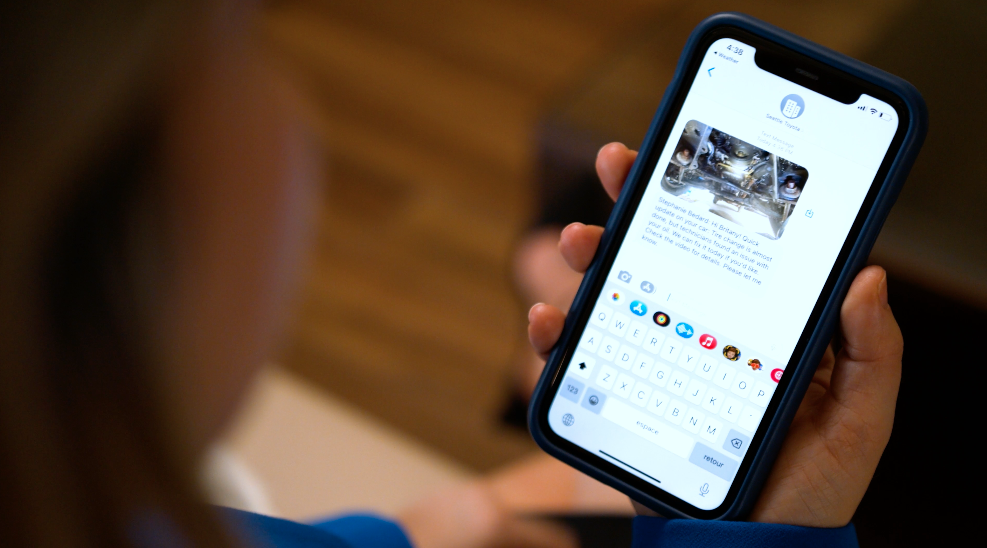
Send that same estimate as a photo with line items and an approve button and the median response is six minutes. Same customer, same repair, same money on the line. The only thing that changed is whether they could see what you were talking about.
This guide covers what each piece of software in your store does, why your DMS leaves the lane uncovered, and what to ask a vendor before you sign.
What software does a dealership service department need?
A service department needs a DMS for the record and a service lane layer for the customer. Most stores also touch a sales CRM, a website and ad platform, and a reputation tool, but those belong to other departments. Here is the full stack with what each piece owns.
| Layer | What it owns | Who lives in it | Common options |
|---|---|---|---|
| DMS | Repair orders, parts, warranty claims, accounting, inventory, payroll | Every department | CDK, Reynolds & Reynolds, Dealertrack, Tekion, PBS, Autosoft |
| Service lane software | Inspections, estimates, approvals, texting, payment, loaners, follow-up | Advisors, techs, you | Kimoby |
| Scheduler | Appointment booking and lane capacity | BDC, advisors | Often the DMS, or a dedicated scheduler |
| Sales CRM | Showroom pipeline, lead scoring, nurture | Sales | VinSolutions, DealerSocket |
| Marketing | Website, SEO, paid ads, inbound leads | Marketing | Dealer Inspire, Cox Automotive / Dealer.com |
| Reputation | Review requests, aggregation, sentiment | Marketing, service | Podium, Birdeye, Kimoby |
The trap is buying a separate point tool for each row and ending up with five logins on your advisor's desktop. Every tool that fixes one step and stops adds a tab, and the customer experience falls through the seams between them.
Why isn't my DMS enough for the service lane?
A DMS is built to record what happened, not to run a live conversation. It knows a repair order opened at 9:14 and closed at 4:47. It has nothing to say about the four hours in between when the car sat finished on a lift waiting on a customer nobody had reached. That is not a defect. It was built for accounting, at a different speed than your drive runs.
Here is specifically where a DMS stops covering the service department.
| Gap | What it costs you on the floor | What fills it |
|---|---|---|
| No video or photo inspection | Recommendations get recited over the phone, so they sound like an upsell instead of a fact. Not available natively in any major DMS. | Digital inspection, Video-to-Customer |
| Texting tied to an open RO | You cannot follow up on declined work, run a campaign, or reach a customer between visits. | Two-way texting |
| No one-tap approval | Approvals happen by phone tag, averaging 22 to 23 hours while the bay stays blocked. | Digital estimates |
| No pay-by-text | Every pickup runs through the cashier, 15 to 30 minutes at a time, and stacks up at 5pm. | Kimoby Pay |
| Loaners tracked on paper | Contracts, damage, fuel, and tolls go uncollected. Basic or missing in most DMS platforms. | Kimoby Go |
| Missed calls leave no record | A missed call is not a declined estimate or a lost RO. It is nothing at all, so it never shows up in a report. | Kimoby Voice |
| No campaigns off service history | Declined work, expiring warranties, and lapsed customers sit in the DMS unused. | Kimoby Grow |
| No CSI intercept | An unhappy customer goes straight to the OEM survey and to Google before you hear about it. | CSI surveys |
How do I increase approval rates on recommended work?
Show the customer what you found instead of describing it. A price recited over the phone sounds like an upsell. A photo of a worn pad next to a new one, with the price attached, reads as a fact. Across the platform, inspections the customer approved averaged $628.61, against $320.67 for declined ones.
The customer who turns down a $1,200 verbal estimate on reflex usually is not saying they cannot afford it. They are saying they cannot see it. J.D. Power's 2026 U.S. Customer Service Index Study found 64% of service customers want photo or video documentation with their multi-point inspection, and 26% at mass-market brands receive it. Two out of three are asking for something three out of four are not getting.
The mechanics that move the number:
- Video on the walkaround. Thirty seconds, narrated, sent to the customer's phone.
- Line-item estimates with a price per job, so the customer can approve the brakes and defer the alignment instead of declining everything.
- One-tap approve. Every field the customer has to fill in is a chance to abandon.
- Financing offered at the estimate, not at the cashier, so a big job does not have to become a small one.
How do I get service customers to come back?
Reach out before they need reminding, using the service history already sitting in your DMS. Declined work from six weeks ago, warranties about to lapse, customers due for tires, and anyone who has quietly stopped showing up are all identifiable today and all sitting idle.
Across 871 dealerships, outbound campaigns booked 154,003 appointments and drove $50.5 million in attributed service revenue.
Retention shows the same split. Those stores measured 65.8% year-over-year on a strict cohort basis and 73.9% once reactivated customers are counted. NADA targets 72%. That eight-point spread is the difference between a store that waits for the phone to ring and one that reaches out.
The campaigns worth running first: declined work follow-up, maintenance reminders, missed appointment recovery, recall notices with a booking link, and seasonal tire outreach.
How do I stop missing inbound service calls?
Route the calls you cannot answer to something that captures them instead of a voicemail box. Marchex call analytics put unanswered inbound automotive service calls at 20 to 30% of total volume, clustered in the morning drop-off window when your advisors are heads-down on write-ups.
A missed call is a different loss from a slow approval. A slow approval is revenue delayed and a bay held hostage. A missed call is a customer who wanted to hand you money and could not find anyone to take it, and who leaves no trace in any report you run.
Gary Moe Mazda in Lethbridge started counting after deploying Kimoby Voice. Four out of five repair orders had involved at least one missed call, and 240 missed calls a month are now handled automatically. Nobody at the store knew the scale of it until something measured it.
"Before this, I was seriously looking at hiring someone just to handle our inbound calls. A few months in and I'm really glad we went with this instead."
Andrew Lusignan, Service Manager, Gary Moe Mazda Lethbridge
How do I clear the cashier line at pickup?
Collect payment at approval instead of at pickup. When the customer taps approve on the estimate, they pay in the same thread, so the transaction is closed before they walk in for the keys. Only 4.7% of repair orders currently trigger a digital payment request, even at stores with the capability turned on. Everything else means a counter visit or a card number read aloud.
Two things to check when you evaluate this: whether payments write back to the repair order in your DMS automatically, and whether you can take payment in person on a terminal as well as by text, so the customer who shows up unannounced is not a workaround.
How do I free up my advisors' time?
Automate the messages that do not need a person. Appointment reminders, confirmations, status updates, and vehicle-ready notices are all scriptable, and they are what eats an advisor's morning. Automating them does not replace your people. It gives them back the parts of the job that need a human standing in front of a customer.
What to move off your advisors first, in order: appointment reminders and confirmations, status updates during the visit, missed appointment follow-up, post-visit CSI requests, and declined work follow-up.
What does poor communication actually cost a service department?
The clearest number in Kimoby's Cost of Silence report is the gap per repair order. Across 871 dealerships and 16.8 million repair orders, ROs with a digital conversation averaged $455.08 in customer pay. ROs without one averaged $291.12. That's $163.96 per RO.
Then look at how many ROs get that conversation. 76.3% of repair orders still close without one. Multiply the gap by your own monthly RO count and you have a rough idea of what's at stake. It's a ceiling, not a promise.
Read the methodology before you quote any of it in a meeting. The report is direct about being vendor platform data from stores that self-selected into this, and about the revenue findings being correlations rather than controlled experiments. Bigger jobs naturally generate more conversation.
Three questions to ask about your own store
- What is your average customer pay on repair orders with a digital conversation, versus without?
- What is your median time from estimate sent to customer approval?
- How many customers who had lapsed past a year did you bring back this year?
If the honest answer to all three is that you do not know, that is what this looks like from the inside. Most stores cannot produce these numbers because nothing in their stack generates them.
How do I compare service lane software?
Compare on the capabilities that touch a repair order, not on feature counts. Here is how the categories of service lane tooling stack up.
| Capability | Kimoby | Scheduling-first tools | Communication-only tools | DMS native |
|---|---|---|---|---|
| Texting any customer, not just open ROs | Yes | Varies | Yes | RO-limited |
| Digital and video inspection | Yes | Varies | Varies | No |
| Estimates with one-tap approval | Yes | Varies | Varies | No |
| Mobile and in-person payment | Yes | Varies | Varies | No |
| Loaner fleet management with GPS | Yes | No | No | Basic |
| Voice AI for missed calls | Yes | No | Varies | No |
| Campaigns off DMS service history | Yes | No | Varies | No |
| Declined work follow-up automation | Yes | No | Varies | No |
| Write-back to the DMS repair order | Yes, CDK | Varies | Varies | Native |
Capability categories reflect publicly available product documentation as of August 2026. For named side-by-sides, see the comparison pages.
Five questions to ask any vendor before you sign
- Does it write back to my DMS, or only read from it? Read-only means your advisors are still retyping. Ask which specific fields write back, and to which DMS.
- Can my advisors text a customer with no open RO? If not, you cannot run a campaign, follow up on declined work, or reactivate a lapsed customer.
- What is the median time from estimate sent to approval at stores my size? A vendor who cannot answer this is not measuring the thing that matters most.
- How many tabs does my advisor end up with? Count the logins on the desk today and ask which ones this replaces on day one.
- What does month three look like? Not the demo. Ask them to describe the adoption curve at a store like yours.
There is a name for this layer: the Dealership Engagement System
Everything above, the inspection, the estimate, the approval, the payment, the loaner, the follow-up, adds up to a category. A Dealership Engagement System (DES)™ is a single platform that runs the entire service lane customer interaction, from drop-off through follow-up, connected to your DMS but distinct from it.
The distinction matters when you are comparing quotes. A texting tool fixes messaging and leaves the estimate alone. An inspection tool fixes visibility and stops short of approval. Each one covers a step and hands the customer back to a gap. A DES covers the sequence.
| DMS | DES | |
|---|---|---|
| What it does | Records operations and data | Runs the customer interaction |
| Who uses it | Every department | Service, fixed ops, marketing |
| Customer communication | Basic, usually limited to an open RO | Two-way texting, video, campaigns, payment |
| Role in revenue | Records it | Drives it through approvals and campaigns |
| Replaces the other? | No | No. It runs on top |
You need both. On its own, a system of record tracks every dollar you earned. It does nothing to help you earn the next one.
Frequently asked questions
What software does a dealership service department need?
A dealership service department needs a Dealer Management System for the record and a service lane software layer for the customer. The DMS handles repair orders, parts, warranty, and accounting. The service lane layer handles digital and video inspections, estimates the customer approves from their phone, two-way texting, payment, loaners, and follow-up on declined work. The two run together, and neither replaces the other.
Why isn't my DMS enough for the service lane?
A DMS is built to record what happened, not to run a live conversation. It knows when a repair order opened and closed, but not what the advisor told the customer, whether the customer saw a photo, or whether anyone followed up on declined work. Video inspection, two-way texting beyond an open RO, one-tap approval, pay-by-text, and loaner management are shallow or missing in every major DMS.
How can I increase approval rates on recommended service work?
Show the customer the problem instead of describing it. Send a short video or photo from the inspection with a line-item price and a one-tap approve button. Inspections that customers approved averaged $628.61 against $320.67 for declined ones, and 64% of service customers say they want photo or video documentation with their multi-point inspection while only 26% at mass-market brands receive it.
How fast do customers approve estimates sent by text?
The median digital estimate is approved in six minutes, and 88.2% are approved within one hour. Phone-based approvals average 22 to 23 hours by comparison, which is time the vehicle spends occupying a bay. Source: The Cost of Silence report, 871 dealerships and 16.8 million repair orders.
Do digital inspections and estimates increase repair order value?
Across 16.8 million repair orders, those with a digital customer conversation averaged $455.08 in customer pay against $291.12 without one, a difference of $163.96 per repair order. This is an observed correlation rather than a controlled experiment, since larger jobs naturally generate more communication.
How do I stop missing inbound service calls?
Route calls your advisors cannot answer to a system that captures the request instead of a voicemail box. Between 20 and 30% of inbound automotive service calls go unanswered, concentrated in the morning drop-off window. At Gary Moe Mazda Lethbridge, four out of five repair orders had involved at least one missed call before they started handling them automatically.
What is a Dealership Engagement System (DES)?
A Dealership Engagement System (DES)™ is a single platform that runs the entire service lane customer interaction, from drop-off through inspection, estimate, approval, payment, and follow-up, connected to the DMS but distinct from it. Kimoby is the DES built for franchised dealership service departments in North America.
Does Kimoby integrate with CDK and Reynolds & Reynolds?
Yes. Kimoby integrates with CDK Global including write-back to the repair order, Reynolds & Reynolds, PBS, Tekion, Dealertrack, Autosoft, Keyloop Serti, Dealer Vu, and Quorum, pulling live customer and repair order data to power communication, campaigns, and reporting. See the full integrations list.
How is Kimoby different from a service scheduling tool?
Scheduling tools are built around booking the appointment and managing lane capacity. Kimoby covers the service journey after the booking: inspection, estimate, approval, payment, loaner, declined work follow-up, and campaigns. Many dealerships run a scheduler for booking and Kimoby for everything that touches the customer from drop-off onward.
What does Kimoby cost?
Service Lane OS comes in two tiers, Essential and Pro, with Kimoby Pay, Kimoby Go, Kimoby Grow, and Kimoby Voice available alongside it. Pricing is published on the pricing page, month to month, with no long-term contract.
What is a good service retention rate for a dealership?
NADA targets 72% year-over-year cohort retention. Across the 871 dealerships in the Cost of Silence dataset, retention measured 65.8% on a strict cohort basis and 73.9% counting lapsed-customer reactivation.
See what this looks like in your drive
Read the data first, or watch the product. Both take less time than a callback to a customer who is not picking up.
- Read The Cost of Silence report, 871 dealerships and 16.8 million repair orders
- Score your own service lane, six questions on where your store stands
- Book a demo
Sources
- Kimoby, The Cost of Silence: Dealership Service Report (August 2026). 871 dealerships, 16.8 million repair orders, $5.5 billion in customer pay, 12 months ending February 2026. Source of the $163.96 per-RO gap, the six-minute median approval time, 88.2% approved within an hour, 76.3% of ROs closing with no digital conversation, campaign appointment and revenue totals, the 4.7% payment request figure, and retention figures. kimoby.com/reports/the-cost-of-silence
- J.D. Power, 2026 U.S. Customer Service Index (CSI) Study. 64% of service customers want photo or video with their inspection; 26% of mass-market and 44% of premium customers receive it. jdpower.com
- Marchex call analytics, cited in The Cost of Silence. 20 to 30% of inbound automotive service calls go unanswered.
- NADA service retention benchmark, 72% year-over-year cohort retention.
- Kimoby, Gary Moe Mazda Lethbridge success story. Four of five repair orders previously involved at least one missed call; 240 missed calls a month now handled automatically. kimoby.com/success-stories/gary-moe-mazda-lethbridge
- DriveSure, 2023 Dealership Service Retention Report. 68% of customers prefer text updates during a service visit against 18% for phone calls. drivesure.com
You May Also Like
These Related Stories
Best Service Lane Texting Software for Dealerships (2026)
/Kimoby_Lapse_bts%20(nsbkim)-122%20(1)%201.png)
How to Increase Fixed Ops Revenue at Your Dealership