Best Service Lane Software for Dealerships (2026 Comparison)
Last updated: October 26, 2026
Quick answer: It depends on where your bottleneck is. If you want the whole visit in one platform (texting, video MPI, estimates, payments, loaners, missed calls, and campaigns), we'd point you to Kimoby, and yes, we make it. Xtime fits if scheduling is your main need. myKaarma is built around in-visit communication. Numa and Pam fit if the phone is your only problem.
Your DMS tracks the repair order. It doesn't run your service lane.
Inspection, estimate, approval, payment, follow-up. Most shops run that on four tools that don't talk to each other. Service lane software puts it in one place.
Service lane software is the set of tools a dealership service department uses to run the customer side of the visit, from appointment to inspection to estimate to payment to follow-up. The most complete version is a Service Lane Operating System, which handles the whole workflow in one platform while the DMS stays the system of record. This guide ranks the real options, names what each one is good at, and is honest about where each falls short.
We make Kimoby, which is a Service Lane Operating System for dealership service departments. So yes, we're biased. We'll be upfront about that. But we talk to service managers every week, we know what tools they use, and we'll give you a fair read on every option here.
What's the best service lane software, in short?
Kimoby if you want the most complete service lane workflow in one tool. Texting, video MPIs with AI-drafted estimates (on Pro), digital approvals, mobile payments with surcharging and financing, loaner fleet management with GPS, Voice AI for missed calls, and marketing campaigns. Syncs with CDK (with payment write-back), Reynolds, PBS, Tekion, DealerTrack, Autosoft, and Serti. Month-to-month, with 30 days' notice. Pricing is on the website.
Xtime if your main need is scheduling and lane workflow. Appointment management is its core. Engagement and payments after the car hits the bay are less of a focus.
myKaarma if you're focused on in-visit communication and repair authorizations. Strong during the repair. In our comparison, it didn't cover loaners, Voice AI, or marketing.
CDK Service if you're already deep in the CDK ecosystem and want everything from one vendor. Tight integration. Ask about contract length and total cost.
Dealer-FX / PowerLane if implementation quality and support are your top priority. Well-regarded for lane management. Narrower feature set than a full OS.
TEXT2DRIVE if you want simpler, texting-focused service communication with a lease-expiration feature nobody else has.
Numa, Pam, and Podium if your only problem is the phone. These are AI voice and messaging tools that catch calls and texts. Good at that one job. They don't run inspections, estimates, payments, or loaners, so they sit on top of a service lane workflow rather than being one.
What is service lane software, actually?
It's any tool that helps a dealership service department manage the customer experience from appointment to payment. That's a broad category, and it includes everything from basic appointment schedulers to full operating systems that handle the entire visit.
The tools fall into four tiers.
Tier 1: Schedulers. Xtime, CDK Service scheduling. They manage appointments, lane flow, and capacity. They're the front door. Strong at getting the customer in. Weaker at everything that happens after.
Tier 2: Engagement tools. myKaarma, TEXT2DRIVE, Podium. They handle texting, estimates, and sometimes payments. Good at the conversation. Usually don't cover inspections, loaners, or marketing.
Tier 3: Voice and call tools. Numa, Pam. AI that answers the phone when your team can't and handles the request. Good at catching missed calls. That is the main scope. Everything else in the visit lives in another tool.
Tier 4: Service Lane Operating Systems. Kimoby. Covers the full workflow from drop-off to payment to follow-up in one platform. Texting, video MPI, digital estimates with AI, mobile payments, loaner management, Voice AI, CSI, campaigns. The DMS stays as your system of record. The OS handles the actions.
Most dealerships end up stacking tools from different tiers: Xtime for scheduling, myKaarma for texting, Numa for missed calls, TSD for loaners, Sunbit for financing. That's five vendors, each with its own login and invoice. The idea behind a service lane operating system is that you don't need to stack. One tool covers the workflow.
What should you look for when choosing service lane software?
Six things, starting with daily use. Feature checklists don't tell you much.
Will my advisors use it every day? This is the only question that matters and nobody asks it first. If the tool adds complexity, your team will work around it. The ones that stick are the ones advisors keep open all day because they're faster than the alternative. Ask for a live demo with a real RO. Watch how many clicks it takes to send a video, get an approval, and collect payment. If it's more than a few, keep looking.
Does it connect to my DMS? The dividing line. If the software talks to CDK, Reynolds, PBS, Tekion, or whatever you run, your advisors never type a customer name or RO number twice. Customer data, vehicle history, and repair orders flow automatically. If it doesn't connect, you bought a fancy group chat with extra steps.
Does it handle the full visit or just part of it? Some tools do texting. Some do scheduling. Some just answer the phone. The question is whether you want to stitch several tools together or get one that covers the workflow. There's no wrong answer. But every tool you add is another login and another vendor to manage.
Does it automate the boring stuff? Appointment reminders. Status updates. Vehicle-ready notifications. CSI follow-ups. These should fire without anyone pressing a button. Honda and Toyota of Seattle automated their messages with Kimoby and saved over 160 hours a month on appointment confirmations alone.
Can I measure the impact? If you can't see how the tool affects response time, approval rates, CP revenue per RO, and CSI, you're running blind. The best platforms show you exactly which advisors are using it, which aren't, and what the revenue difference looks like.
How good is the onboarding? Bad implementation kills great software. Ask who handles setup, data migration, DMS mapping, and go-live support. Ask if they do in-person training. Ask how long it takes to get fully live. If the answer is "we'll send you some videos," think twice.
How do the main platforms compare?
Kimoby
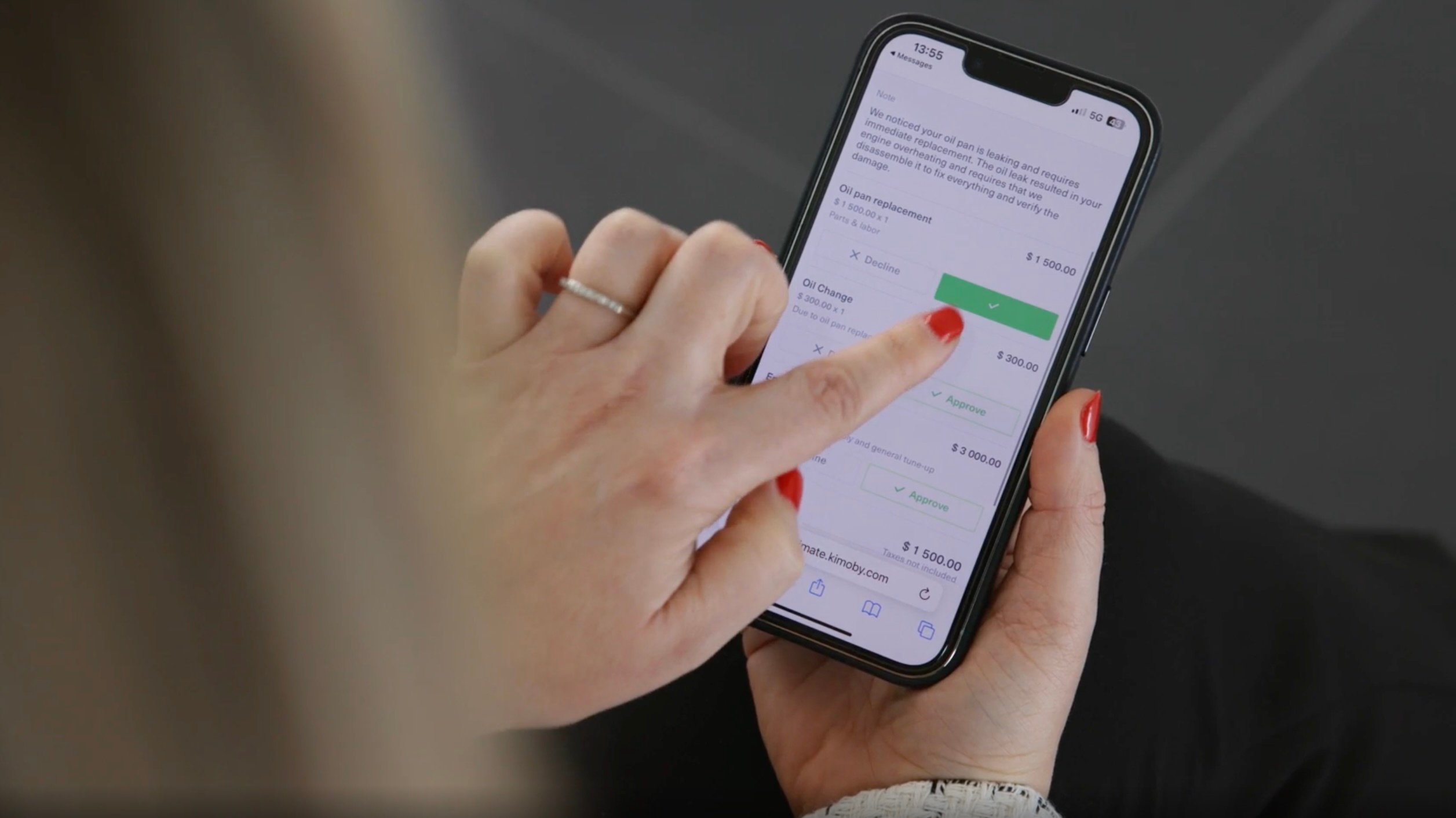
That's us. With Kimoby, a franchised service department runs the whole visit on one Service Lane Operating System. That covers texting, video MPIs with AI-drafted estimates on Service Lane OS Pro, digital estimates with one-tap approve or decline, mobile payments with credit card surcharging and Affirm financing, in-person payment terminals, loaner fleet management with GPS tracking and digital contracts, Voice AI for missed calls, automated status updates, CSI follow-up, and marketing campaigns for declined work, recalls, and retention.
RO sync with CDK (including payment write-back), Reynolds, PBS, Tekion, DealerTrack, Autosoft, and Serti. Approved for over-the-air loaner management with Toyota, Lexus, and Mercedes-Benz. BMW Activities Fund approved vendor with myBMW app integration. VW eConnect and CMC approved. More than 1,000 dealerships across North America have used it.
Where we fall short: no native online scheduler yet (it's on the roadmap). Kimoby Voice doesn't book appointments yet. Payment write-back works on CDK only, and Tekion is pull only. We're not on Ford's FCP approved vendor list, so Ford stores using Kimoby self-attest with Ford. Our US reference base is still growing since we're a Canadian company expanding stateside.
See the product. | See pricing.
Xtime
Xtime is built around scheduling. If your biggest problem is appointment management, lane flow, and capacity planning, that's its home turf. It's deeply integrated with most DMSs and has been around long enough that most service managers have used it at some point.
Where it falls short: Xtime started as a scheduler, and its engagement features grew around that. The texting, video, and payment capabilities are there, but they're not the focus. If your bottleneck is getting customers into the lane, Xtime is your tool. If your bottleneck is what happens after they arrive, you'll need something else on top.
Pricing is modular. Add-ons like Spectrum, Engage, and Inspect are priced on top of the base, so ask for the full quote. Full Kimoby vs Xtime comparison.
myKaarma
myKaarma is Kimoby's most direct competitor in the engagement and approval space. Strong on in-visit service communication, repair authorizations, and scheduling. Good CDK and Reynolds integration.
Where it gets tricky: ask about contract length and setup fees. When we last compared, it didn't offer loaner management, Voice AI, in-person terminals, or marketing campaigns. If you need those, you're stacking vendors again. Full Kimoby vs myKaarma comparison.
CDK Service / CDK Digital Service
If you're a CDK shop and you want everything from one vendor, CDK Service is the path of least resistance. Tight ecosystem integration. No third-party connection fees. iPad-based for advisors, phone-based for techs.
The trade-off: ask for the full cost, including training, and the contract length. And because CDK is a DMS company first and a service lane tool second, the engagement features aren't its main focus. Full Kimoby vs CDK Service comparison.
Dealer-FX / PowerLane
Dealer-FX gets consistently good marks for implementation quality and customer support. Their PowerLane product is solid for lane management, check-in, and inspection workflows. Often chosen by stores that prioritize support and a smooth rollout over having every feature under one roof.
The limitation is scope. PowerLane covers the visit well but doesn't extend into payments, loaners, Voice AI, or post-visit marketing the way a full OS does.
TEXT2DRIVE
The simpler, texting-first option. Good communication and reminders, mobile payments, and a lease-expiration feature we haven't seen elsewhere. If you want focused service lane texting without the full operating system, TEXT2DRIVE is a solid choice.
The trade-off: it's not a full workflow tool. In our comparison, it had no digital MPI, AI estimates, or loaner management. Full Kimoby vs TEXT2DRIVE comparison.
Numa
Numa is an AI voice tool built to catch missed calls at dealership service departments. When nobody picks up, Numa answers, handles the request, and can book appointments on its own. For stores whose single biggest leak is the unanswered phone, it does that job well, and it's the most visible name in the dealership voice-AI category.
The trade-off is scope. Numa is a phone tool. It doesn't run inspections, estimates, payments, loaners, or marketing, so it lives alongside your service lane workflow rather than being one. If you go this route, plan for it to be one vendor among several. Full Kimoby vs Numa comparison.
Pam
Pam is an AI receptionist for repair shops and dealerships. Like Numa, its focus is the phone: answering calls around the clock, booking service, and following up by voice and text. It integrates with scheduling tools and pushes appointments into the workflow.
And like Numa, it's a point tool. Pam handles the call. It is not a service lane operating system, so inspections, digital estimates, payments, and loaner management still need their own software. Useful if the phone is your one problem, not a fit if you're trying to consolidate the whole lane.
Podium
Podium is a broad small-business messaging and reputation platform: reviews, webchat, texting, and an AI responder. Plenty of dealerships use it, mostly on the sales side and for review generation. It's polished and well-known outside automotive.
For a service department, the gap is specificity. Podium isn't built around the repair order, the DMS, the inspection, or the loaner. It's a general communication layer, not a service lane workflow, so it covers the conversation but not the visit. Full Kimoby vs Podium comparison.
What does a complete service lane platform cover?
Instead of comparing features across vendors (which change constantly), here's what a complete workflow requires, and where Kimoby stands. Ask every vendor on your shortlist which of these they cover natively, which require add-ons, and which they don't do at all.
| Capability | Why it matters | Kimoby |
|---|---|---|
| Texting that connects to the RO | Median digital estimate approval is 6 minutes, against 22 to 23 hours by phone | Yes |
| Automated reminders and status updates | Cuts no-shows and kills "where's my car?" calls | Yes |
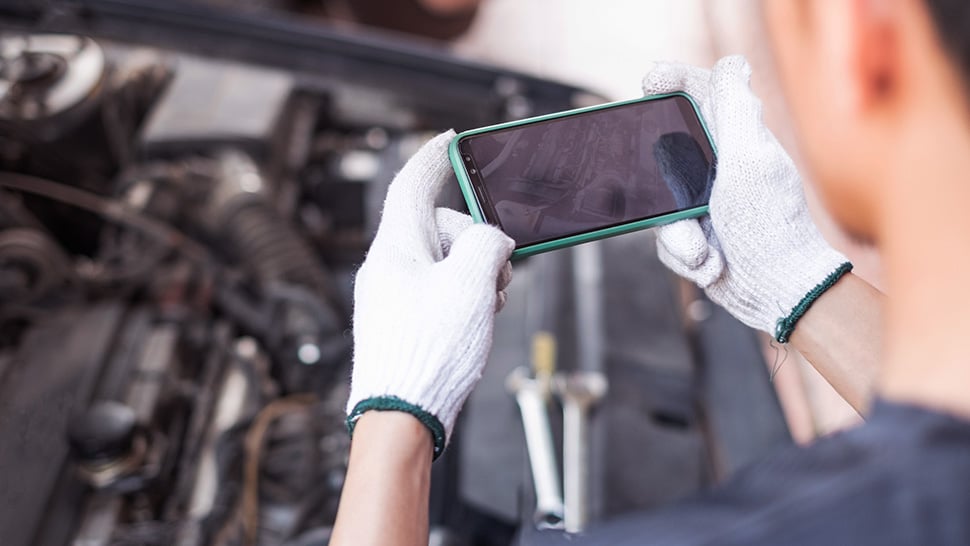
| Video MPI / digital inspections | Approval rates double when customers see the problem (J.D. Power 2024) | Yes, with AI-drafted estimates from the video on Pro |
| Digital estimates with approve/decline | Customer taps approve on their phone. No more waiting for a callback. | Yes |
| Mobile payments | Customer pays before pickup. Cashier line disappears. | Yes (surcharging on credit up to 3% in the US and 2.4% in Canada, not in Quebec, plus Affirm financing) |
| In-person payment terminals | One payment system for mobile and in-store | Yes |
| Loaner fleet management | Digital contracts, GPS tracking, damage documentation, automated billing | Yes |
| Voice AI for missed calls | When nobody picks up, AI catches the call, summarizes it, and lets the caller switch to text | Yes |
| CSI follow-up automation | Catch issues before the OEM survey goes out | Yes, with sentiment analysis |
| Declined work and recall campaigns | Fill soft days. Bring back revenue you already earned once. | Yes |
| CDK payment write-back | Payments push back to the RO automatically | Yes |
| Reynolds integration | Full data sync | Yes |
| PBS integration | Full data sync | Yes |
| Tekion integration | Growing DMS install base | Pull only |
| Online appointment scheduling | Customers book themselves | On the roadmap |
| OTA loaner program approval | Meet the OEM loaner mandate and track mileage automatically | Toyota, Lexus, Mercedes-Benz approved |
| OEM program compliance (BMW, VW, Ford) | Meet the mandate and make money from it | BMW approved. VW approved. Ford: not on the FCP approved list. Stores self-attest. |
| Month-to-month contract | Cancel with 30 days' notice if it doesn't work | Yes |
| Public pricing | Know what you're paying before the sales call | Yes (see pricing) |
When you're evaluating vendors, print this list and ask each one to fill in their column. That tells you more than any comparison article can.
Two stores that switched to a full Service Lane OS
Honda and Toyota of Seattle
Two high-volume stores, each handling 90 to 150 cars a day. Every customer interaction happened by phone. Advisors were buried, and checkout meant an end-of-day lineup.
With Kimoby, they automated the routine messages: confirmations, reminders, advisor intros, and vehicle-ready notices. They now save over 160 hours a month on appointment confirmations alone. Over 75% of customers pay by phone before picking up, and the end-of-day lineups went away.
"Prior to Kimoby, the customer experience was such a hassle. We couldn't connect with our customers fast enough. Kimoby has made a huge impact on our bottom line."
Arvin Merino, Service Manager, Honda and Toyota of Seattle
Martin Grove Volkswagen
Recalls meant pulling lists from the DMS and matching VINs to customer records by hand. It was slow and often incomplete. With VIN matching from the DMS and recall texts, what took hours takes minutes. Customers confirm appointments or ask questions right from the text.
"Kimoby is more than just a communication tool, I believe that's just skimming the surface. It has really changed the way we do business and I couldn't imagine operating our service department without it."
Jason Zommers, Fixed Ops Manager, Martin Grove Volkswagen
What if your OEM is pushing you to get service lane software?
Start with your OEM's approved list. Ford, BMW, VW, Toyota, Lexus, and Mercedes-Benz all push digital inspections, video MPI, or connected loaner management. If your rep just told you to "find a vendor," here's where we stand.
Toyota, Lexus, and Mercedes-Benz loaner programs: Kimoby Go is approved for over-the-air loaner management, tracking mileage and vehicle data directly so loaners stay within OEM limits without manual logs.
BMW Activities Fund: We're an approved vendor, with a direct integration to the myBMW app.
VW eConnect and CMC: We're approved for both the service lane program and the loaner management program.
Ford Commitment Program: Ford stores can use Kimoby for the FCP video inspection requirement. Kimoby isn't on Ford's approved vendor list, so your store self-attests and sends its invoices to Ford. Ask your Ford rep exactly what to send and when. In Canada, the FCP video requirement doesn't apply.
One thing to watch: if you pick a tool that only covers the OEM requirement (video MPI, or a connected loaner feed) but nothing else, you'll need additional vendors for payments, campaigns, and engagement. The mandate is a good reason to evaluate your whole stack, not just add one more tool on top.
Questions we hear every week
What is the best service lane software for dealerships?
If you want the most complete workflow in one platform (texting, video MPI, estimates, payments, loaners, Voice AI, and campaigns), we'd point you to Kimoby, and we're biased. It syncs with CDK, Reynolds, PBS, Tekion, DealerTrack, Autosoft, and Serti. Xtime is the best option if scheduling and lane flow are your primary need. myKaarma is strong for in-visit communication. Numa and Pam are options if your only problem is missed phone calls.
What is a Service Lane Operating System?
Software that manages the entire service visit from drop-off to payment in one platform. It goes beyond texting, scheduling, or call answering to include inspections, estimates, approvals, payments, loaners, Voice AI, status updates, CSI, and campaigns. The DMS stays as the system of record. The OS handles the actions.
How is a service lane operating system different from a voice AI tool like Numa or Pam?
A voice AI tool answers the phone when your team can't, handles the request, and may book the call. That is its main scope. A service lane operating system like Kimoby includes Voice AI for missed calls and also runs inspections, estimates, payments, loaners, and campaigns in the same platform, connected to the repair order. The voice tool is one feature of the workflow. The OS is the workflow.
Can Kimoby replace Xtime?
For everything except the online scheduler, yes. With Kimoby, you run texting, video MPI, estimates, payments, loaners, Voice AI, and campaigns. A native scheduler is on the roadmap, so you'd keep your existing scheduler for now.
Can Kimoby replace myKaarma?
For most stores, yes. You get texting, video, estimates, and payments, plus loaner management, Voice AI, in-person terminals, surcharging, and marketing campaigns. It's month-to-month with 30 days' notice.
Does Kimoby integrate with CDK?
Yes. Repair orders sync from CDK, and completed payments write back to the CDK repair order automatically. Estimate and RO-line write-back is in development.
Which DMSs does Kimoby work with?
CDK (with payment write-back), Reynolds, PBS, Tekion (pull only), DealerTrack, Autosoft, Serti, Dealer Vu, and Quorum. The full list is on our integrations page.
Is Kimoby approved for OEM loaner and inspection programs?
Kimoby Go is approved for over-the-air loaner management with Toyota, Lexus, and Mercedes-Benz. We're a BMW Activities Fund approved vendor with myBMW app integration, and approved for VW eConnect and CMC. For Ford, we're not on the FCP approved vendor list. Ford stores can still use Kimoby and self-attest with Ford.
Should I stack multiple tools or use one platform?
Depends on your tolerance for complexity. Stacking Xtime, myKaarma, Numa, TSD, and Sunbit gives you best-of-breed in each category but five vendors to manage. A service lane operating system like Kimoby puts most of the workflow on one platform, with the trade-off that no single tool is perfect at everything.
The bottom line
Service lane software isn't optional anymore. Between OEM mandates, customer expectations, and the math on what phone tag costs you every month, the question isn't whether to get one. It's which one.
If you want the best scheduler, get Xtime. If you want the best in-visit communication, myKaarma is strong. If your only leak is the phone, Numa or Pam will catch it. If you want the most complete service lane workflow under one roof, from inspection to payment, that's what we built Kimoby to do.
If you want to see it, book a demo. We'll text you during the call so you can see it on your phone. That usually settles it faster than any article can.
Sources
- Kimoby, The Cost of Silence (2026). Analysis of 871 dealerships, 16.8 million repair orders and $5.5 billion in customer pay. Source for the 6-minute median approval time. Phone approval time (22 to 23 hours) is industry data cited in the report.
- J.D. Power 2024 Aftermarket Service Index. Video/photo MPI doubles customer approval rates (24% to 51%).
- Kimoby case study: Honda and Toyota of Seattle. 160+ hours saved monthly on appointment confirmations. 75%+ of customers pay by phone.
- Kimoby case study: Martin Grove VW. Recall campaigns reduced from hours to minutes.
You May Also Like
These Related Stories

How to Improve Your Dealership's Customer Communication
Best Video Inspection Software for Dealerships (2026)